Rat Catheters: Direct Blood Pressure and Blood Sampling

The technique of using these rat catheters is for conscious, relatively unrestrained, rats with indwelling catheters. Rats prepared with chronically implanted catheters avoid possible adverse influences of anesthesia, acute effects of surgery, and stress from handling and restraint. Drugs can be administered by many routes: intravenously into the general circulation, into the portal vein, or internally into the small intestine. Non-irritating drugs can be given subcutaneously or intraperitoneally. Systemic venous blood (inferior or superior vena cava) and portal vein blood can be sampled. If pulmonary metabolism is not a factor, an aortic cannula provides the equivalent of a mixed venous blood sample.
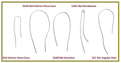

S24 Rat Aorta Catheter, PE20 150mm long, PE10 cut for intravascular portion 12mm
S24A Bile Duct Catheter, to be used with the S26C Duodenal Cannula
S25 Jugular Vein Catheter, PE20 170mm, PE10 65mm, Silastic 0.025" OD 37mm
S25A Portal Vein Catheter, tip beveled for injections or infusions, PE20 140 mm, PE10 40mm,Silastic 0.025" OD 25mm
S25B Rat Portal Vein; tip blunt level for blood sampling, data the same as S25A
S26 Inferior Vena Cava Catheter, via laparotomy, PE20 50mm, PE10 40mm,
Silastic 0.025" OD 80mm
S26A Rat Inferior Vena Cava Catheter, via femoral and iliac veins, PE20
100mm, PE10 100mm, Silastic 0.025" OD 70mm
S26B Rat Intestine Catheter, for injections/infusions, PE20 75mm, PE10 40mm,
Silastic 0.025" OD 125mm
S26C Rat Duodenum Catheter, Upjohn design for use with S24A Bile Duct
Catheter
S27 Rat Jugular Vein Catheter, (modified Harms & Ojeda, for blood sampling,
PE20 170mm, Silastic 0.037" OD 70mm

Chronic venous cannulas in rats were developed initially for self-administration of drugs in experimental addiction. Drugs with a short duration of action and powerful acute effect pose a special problem when safety tests must be by the intravenous route.

Catheters come in 10 different types. They are comprised of PE10, PE20 and silastic. The catheters can be ordered in either a “hybrid end” or “reinforced end”. State which ever option when ordering the selected catheters. In addition all IITC catheters have a flared end.

They can be used for blood sampling, withdrawal. A full line of accessories for the IITC catheters are available. They include plugs, connecting tubing’s, U tubes, blunt end needles.

The IITC catheters can also be customized. In order to process a custom order a drawing must be supplied with exact dimensions. Without a drawing we cannot accept orders.


Thermometers and Temperature Probes

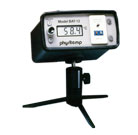
In the lab: Readings to 0.1° C; near perfect stability.
In the field: A superior'cold junction reference'which
maintains accuracy with ambient temperature changes from O°C to 50°C; sealed construction, carrying case.
For recording: Analog output for strip chart recording is a standard feature.
BAT-12 is the ideal instrument for use with microprobes.
These 5 sensors are among our most popular and there are many more to choose from:

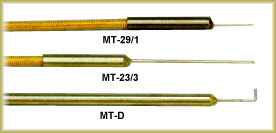
Flexible Implantable Microprobe, IT18
Needle Microbrobe, MT-26/2
Surface Probe, BT-1
General Purpose Probe, HT-1
Sensor Six Pack, PT-6

BAT-12 Specifications
Temperature Range: -100°C to +200°C
Resolution: 0.1°
Accuracy: 0.1°C ± 1 digit between 0-50°C
0.1% ± 1 digit over full range
Calibration Conformity: Follows NIST
thermocouple tables within 1 digit
Ambient Temperature
Compensation: Auto-compensated to 0.1°C from 0°C to 50°C
Readout: 3 1/2 digits, 1/2" liquid crystal
numerals
Input Socket: Miniature, quick disconnect,
copper-constantan
Analog Output: lOmV per degree C, approx.
Power Supply: Model BAT-12 9V transistor
battery, available everywhere
Model BAT-12R AC 115V and Ni-Cad battery
with charger
Size, Weight: 5" x 2 1/2" x 6" - 2 lbs., including carrying case

Temperature Probes


IITC Life Science Inc.
23924 Victory Blvd Woodland Hills, CA 91367
818 710 8843 fax 818 992 5185
 
  Copyright (c) 2007. IITC Life Science
All rights reserved.
 
Free Sitemap Generator